
Bone loss in teeth means the support around your tooth roots is shrinking. Dental bone loss occurs when the jawbone supporting your teeth deteriorates and loses its density, most commonly caused by untreated periodontitis (advanced gum disease) and missing teeth. Loose teeth and receding gums are common signs. A dentist can confirm it with an exam and X-ray, and treatment can often stop it from getting worse.
This guide will help you learn more about tooth bone loss, symptoms, and treatments.
What is Bone Loss in Teeth?
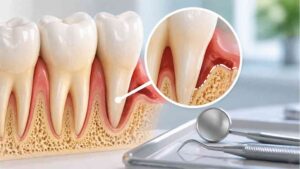
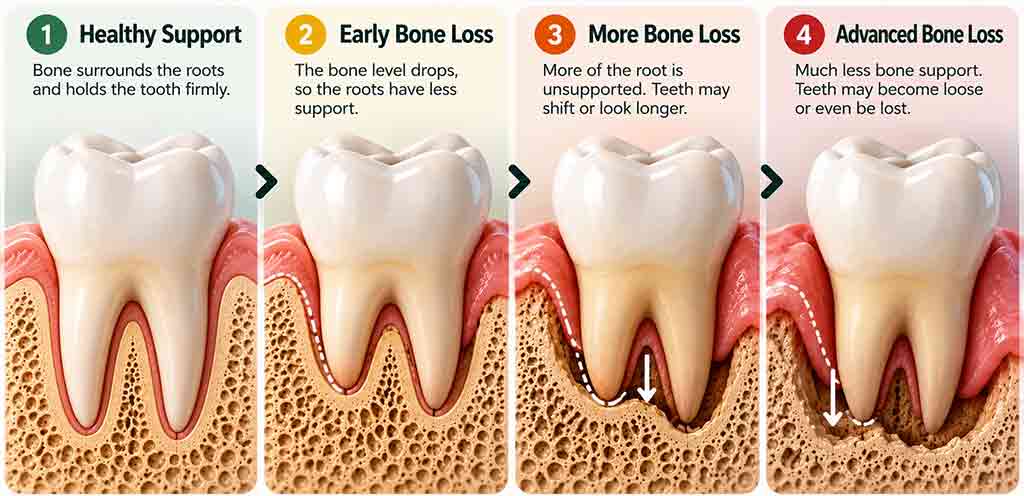
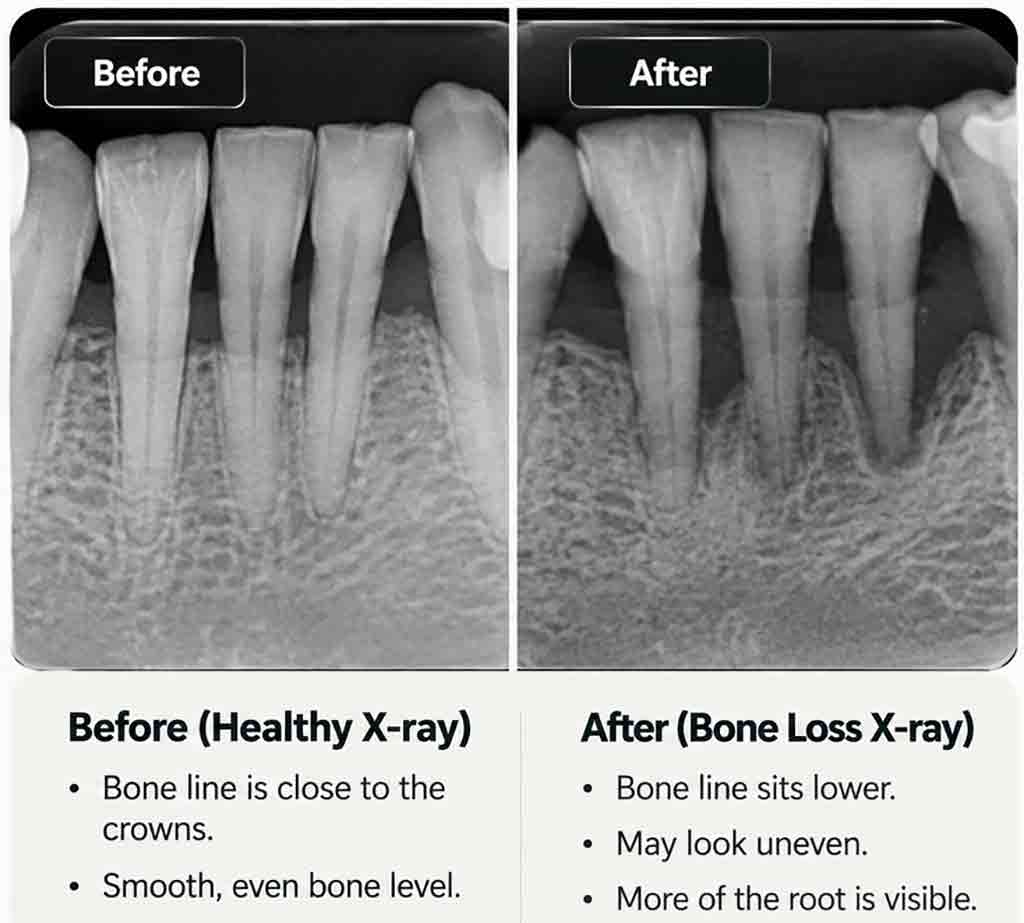
Your teeth sit in sockets in the jawbone. Healthy bone surrounds the tooth roots and gives them the support they need to stay firmly in place. Dental bone loss happens when the level of this supporting bone drops, leaving more of the tooth root without bone around it. Dentists may also call this jaw bone loss.
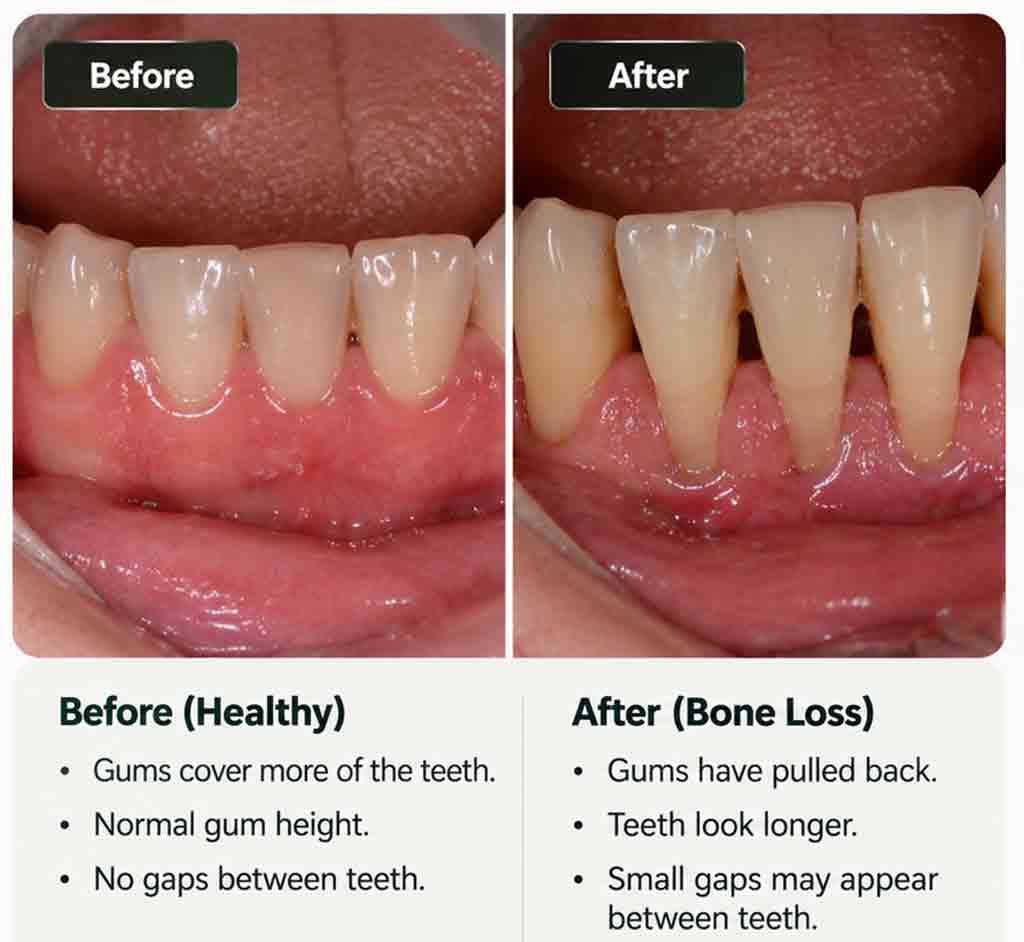
Early bone loss may not feel different. As more supporting bone is lost, a tooth has less to hold it steady. Teeth may start to loosen or shift, while receding gums can make them look longer.
Is bone loss in teeth common? Yes. In national survey data from 2009 to 2014, nearly half (42%) of adults aged 30 and older had periodontitis (CDC), a form of gum disease that often comes with bone loss. Because early bone loss often has no signs, many people do not know they have it. Dentists see and treat it every day. Learning about the causes of bone loss in teeth can help you spot risk factors early.
What Is Dental Bone Resorption?
Dental bone resorption is the process in which the body breaks down and removes bone around the teeth. When bone is lost faster than it can be maintained, the amount of bone supporting the tooth decreases.
As bone resorption in teeth progresses, the roots have less support, which can eventually make teeth loose or unstable. Jaw bone resorption can also leave less bone available if a dental implant is needed later.
A dentist can measure the amount of remaining bone with an exam and dental X-rays. Treatment depends on how much bone has been lost and whether the affected teeth can still be supported.
Signs of Bone Loss in Teeth
Bone loss in teeth symptoms can be easy to miss at first. Watch for these six, which also show up in gum disease (Mayo Clinic):
- Loose Teeth: A tooth may wiggle or feel less firm when you bite.
- Receding Gums: The gums pull back, exposing more of the tooth.
- Longer-Looking Teeth: Teeth may appear longer as the gums and supporting bone sit lower.
- New Gaps or Shifting Teeth: Spaces may develop between teeth, or teeth may move out of position.
- Bite Changes: Your upper and lower teeth may no longer meet the way they used to.
- Red, Swollen, or Bleeding Gums: Gums may feel tender or puffy and bleed when brushing or flossing.
Many of these signs can have other explanations, and early bone loss often has no signs at all. Only an exam and X-ray can confirm it.
What Does Bone Loss in Teeth Look Like?
In the mouth, bone loss may be associated with receding gums, longer-looking teeth, or new gaps. On an X-ray, the bone level may appear lower around the tooth roots.
Bone Loss in Teeth Treatment Options
Treatment for tooth bone loss has two goals:
- Stop more bone from being lost.
- In some cases, rebuild some of what was lost.
It cannot always bring back all of the bone. The right treatment depends on how much bone is left and the health of your gums and teeth.
| Treatment | What It Does | Often Considered When | Limits |
| Deep cleaning | Cleans below the gumline and smooths the roots | Bone loss is early | Does not rebuild bone on its own |
| Laser or pocket reduction surgery | Cleans deep pockets so the gums fit snugly again | Deep pockets remain after cleaning | Healing and results differ from person to person |
| Bone graft | Adds material where bone is missing | Bone is missing around a tooth, or before an implant | Results vary |
| Guided tissue regeneration | Uses a thin barrier so bone and tissue can regrow | A tooth with bone loss can still be saved | Results vary, and it is often paired with a graft |
| Implant or bridge | Replaces a tooth that cannot be saved | The tooth has lost too much bone to keep | Implants need enough bone, so a graft may come first |
Deep Cleaning (Scaling and Root Planing)
Deep cleaning is often the first treatment when gum disease has caused bone loss around the teeth. The dentist removes plaque and hardened tartar from below the gumline and smooths the roots so the gums can heal and fit more closely around the teeth.
Local anesthesia is often used. After treatment, your dentist measures the pockets again to see how well the gums responded. This type of periodontal treatment can help control gum disease and limit further damage, but it does not rebuild bone that has already been lost.
Laser and Pocket Reduction Surgery
If deep pockets remain after cleaning, surgery may be needed to make them smaller. With pocket reduction surgery, the dentist lifts the gum tissue, cleans the roots and surrounding area, and places the gums back more closely around the teeth.
Laser treatment, including LANAP, may be another option for some deep pockets. The goal is also to treat the affected area and reduce the pocket. Whether laser or conventional surgery is appropriate depends on the extent of the disease and your dentist’s evaluation.
Dental Bone Grafts
A bone graft is used when the goal is to rebuild some of the bone that has been lost. Graft material is placed in the affected area and acts as a framework for new bone to grow around.
The material may come from your own body, a donor, or a synthetic source. Bone grafting may be used to support a tooth being saved or to build enough bone for a future dental implant. How much bone can be rebuilt depends on the individual case.
Guided Tissue Regeneration
Guided tissue regeneration helps create space for bone and supporting tissue to regrow. A thin membrane is placed between the gum and bone, preventing faster-growing gum tissue from filling the area first. It is often combined with a bone graft. In some cases, additional materials such as tissue-stimulating proteins or platelet-rich plasma may also be used to support healing.
Replacing a Tooth That Cannot Be Saved
If too much supporting bone has been lost to save a tooth, the next step may be replacing it. Options can include a bridge or a dental implant.
A bridge uses nearby teeth for support. An implant is placed in the jawbone, so there must be enough bone to support it. If there is not enough bone, a graft may be considered first. Your exam and X-rays help determine which replacement option is possible.
Is Bone Loss in Teeth Serious?
Yes, tooth bone loss can be serious because it reduces the support that keeps your teeth stable. As it progresses, it can:
- Make teeth loose or lead to tooth loss.
- Change your bite and make chewing harder.
- Cause discomfort in some cases.
- Make dental implant placement more complicated if there is not enough bone.
- Affect the appearance of your teeth and gums.
Many teeth with bone loss can still be treated and managed. In some cases, regenerative treatments can rebuild some lost bone. What is possible depends on how much bone remains and the condition of the tooth and surrounding gums.
Can Bone Loss in Teeth Be Reversed?
Jaw bone loss can sometimes be partially reversed, but lost bone does not usually grow back on its own. Whether it can be rebuilt depends on how much bone was lost and where the damage occurred.
Deep cleaning and other gum treatments can help control the disease and limit further damage, but they do not replace lost bone. In suitable cases, bone grafting or regenerative procedures may help the body rebuild some supporting bone around the teeth.
Advanced bone loss is harder to rebuild because there may not be enough healthy bone and supporting tissue remaining. In these cases, treatment may focus on controlling the disease, keeping the tooth stable for as long as possible, or replacing a tooth that cannot be saved.
A dentist can determine what is possible by examining the gums and checking the remaining bone on X-rays.
How Dentists Check for Bone Loss
A dentist checks for tooth bone loss in two main ways:
- Gum Measurements: A small probe measures the space between your gums and teeth. Healthy spaces are usually 1–3 mm deep, while depths over 4 mm may point to gum disease and bone loss (Mayo Clinic).
- Dental X-Rays: X-rays show the bone around each tooth root and help the dentist see where and how much bone has been lost.
In some cases, a dentist may use a 3D scan (CBCT) for a more detailed view of the bone. Not every case needs one.
Get Help With Bone Loss in Your Teeth
If you need help with bone loss in your teeth, Noah Smile Group can evaluate your teeth, gums, and bone levels and explain your treatment options. At your visit, we’ll discuss your symptoms, examine your mouth, and take X-rays when needed. Our focus is on finding the right next step for you, without judgment.
Dr. Moise Nawlo is a Brooklyn dentist at Noah Smile Group who provides dental implants. He earned his DDS from NYU and has advanced training in implant dentistry and the LANAP® Protocol for periodontal treatment.
If you’re concerned about bone loss, contact Noah Smile Group or call (347) 720-9068 to schedule an evaluation.
This page is for general information and does not replace an exam or advice from your dentist.