A healing cap on a dental implant is a small piece that sits on top of the implant while your gum heals, so the gum can shape itself around it and your dentist can reach the implant later. Gums usually take 4 to 6 weeks to heal around abutments, so expect the cap to stay on for a few weeks or longer. The exact time depends on your surgery and how your body heals.
What Is a Healing Cap on a Dental Implant?
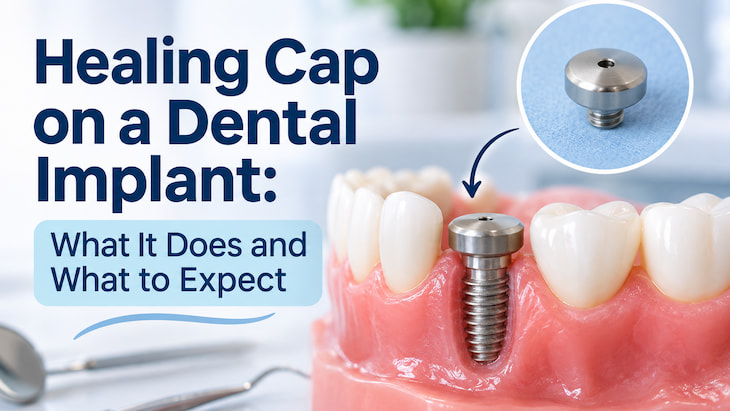
A healing cap on a dental implant is a small, temporary piece that your dentist attaches to the top of the implant. It helps the gum heal around the implant and keeps the spot open so your dentist can attach the final tooth later.
The cap sits on the implant post, the screw-like part your dentist places in your jaw. Many dentists say healing abutment for the same part. The healing cap on implant sites sits above the soft tissue, so you may see it or feel it with your tongue. That is normal.
A dental implant healing cap is temporary. Your dentist replaces it with the final abutment and crown. If you still weigh ways to replace a tooth, read about our tooth replacement options.
Why Dentists Use a Healing Cap
A healing cap does three jobs while the gum heals. Here are the main reasons dentists use one.
- It helps shape the gum around the implant. The cap guides the gum toward a natural contour around your future crown.
- It keeps the implant easy to reach. The cap stays on until the gum has healed around the implant, so the spot stays marked for your dentist.
- It helps protect the site from food and plaque. It covers the top of the implant early after surgery.
A 2024 systematic review of five clinical studies compared customized and conventional healing abutments. The findings suggest that customized abutments can help maintain the surrounding soft and hard tissues and improve aesthetic outcomes. However, the authors call for larger studies with longer follow-up periods before drawing firm conclusions. Bone healing, called osseointegration, is a separate process in which the bone attaches directly to the implant, forming a stable connection.
When Is the Healing Cap Placed? One-Stage and Two-Stage Implants
Your dentist places the cap at a different time on each of the two surgical paths. In one-stage surgery, the dentist can place the abutment at the same time as the implant. In two-stage surgery, the dentist first places the implant below the soft tissue and lets it heal. A small second procedure then uncovers the implant, and the cap goes on.
Path | When the cap goes on | Extra procedure? | What you may notice |
One-stage | Same visit as the implant | No | The cap above the gum soon after surgery |
Two-stage | At a second step, after the implant heals under the gum | Yes, a small one | A closed gum first, then the cap |
Some one-stage systems skip the second step. Your dentist picks the path that fits your mouth and your plan. Read more about single dental implants in Brooklyn, or see how a bone graft works if your jaw needs support first.
How Long Does an Implant Healing Cap Stay On?
An implant healing cap often stays on for a few weeks, and the exact time depends on the type of surgery. Two clocks run at once: a short gum clock and a longer bone clock.

Sources: UM Health patient library, American Academy of Periodontology, Cleveland Clinic
Some online timelines mix up the two clocks, which is one reason they disagree. In a one-stage case, a dental implant healing cap goes on at surgery, so it may stay on longer than a cap that goes on at the second step. Your dentist decides the date.
Healing Cap vs. Healing Abutment vs. Cover Screw vs. Final Abutment
This table sorts out the part names.
Part | Where it sits | Visible? | Temporary or lasting? | What it does |
Healing cap | On the implant, above the soft tissue | Often yes | Temporary | Helps gum tissue heal around the implant |
Healing abutment | Same part as the healing cap | Often yes | Temporary | Same job, different name |
Cover screw | Under the gum in a two-stage case | No | Temporary | Stays under the gum while the implant heals below the soft tissue |
Final abutment | On the implant, under the crown | Mostly hidden | Lasting |
On the healing cap vs. healing abutment question, the answer is short: they are the same part with two names. On the healing cap vs. cover screw question, the cover screw is a different piece that you will not see, because it stays under the gum until the second step.
What Is Normal and What Is Not?
Most people feel some soreness after implant surgery. This list does not replace your dentist’s advice.
Here’s what is usually normal:
- Some discomfort, swelling, bruising, or minor bleeding in the first days
- A soft food diet for the first few weeks
- A cap you can see or feel above the gum
Call your dentist if you experience:
- Swelling or soreness that gets worse
- A loose or wobbly implant, or a loose cap
- Bleeding gums or swollen gums
- Fever, or pus around the implant
- Swollen lymph nodes in your neck, plus any symptom above
How to Care for Your Healing Cap
Your dentist’s own instructions come first. Here are a few basics that apply to most people.
- Brush with a soft-bristled toothbrush. One dental school notes you can use the same soft brush and toothpaste as on natural teeth.
- Floss as your dentist advises. The same dental school says plaque removal matters as much as ever.
- Stick to soft foods while the area heals.
- Leave the cap alone. Do not twist, poke, or pick at it.
- Keep every follow-up visit, since your dentist checks your progress at regular visits.

What If the Healing Cap Comes Off or Feels Loose?
Call your dentist’s office the same day. Our office is open Sunday to Friday, 10:00 am to 5:00 pm, and closed Saturday. Until your dentist sees you, follow these three steps.
If your cap comes off or feels loose
- Keep the cap and bring it with you.
- Do not try to screw it back in.
- Do not chew on that side.
A delay is not ideal, because the cap helps seal the site. A small 2026 study of 12 patients in China found signs of inflammation that lasted in gum tissue where a healing abutment had come loose, so a prompt call is wise. For urgent problems, see our dental emergency care.
What Happens After the Healing Cap Comes Off?
Once the gum heals, your dentist moves to the final parts in a set order.
- The dentist removes the cap.
- The dentist swaps the cap for a transfer coping, a special piece used before the final impression.
- The dentist takes the impression and places the final abutment.
- The dentist places the crown made from your impressions, which is the visible tooth.
The abutment step usually takes about one hour and may need a second minor surgery. The time from cap removal to crown varies, so ask your dentist about your plan.
Does a Healing Cap Cost Extra?
Many patients ask about the cost of a healing cap on a dental implant. We do not quote a price here, because it depends on how your dentist bills your treatment. Our single implant page lists the items in a quote: the scan, the implant, the abutment, the crown, and any extraction or bone graft. Ask whether the healing cap for a dental implant sits inside the implant fee or appears as its own line.
Payment note: Noah Smile Group is not in network with any dental insurance. Our team files claims and paperwork so you can receive any out-of-network benefits your plan allows. Please confirm benefits and financing terms with us. See our payment and financing options.
Why Choose Noah Smile Group for Dental Implants in Brooklyn
Dental implants are the main focus of our practice, established in 2015. Dr. Moise Nawlo, DDS, earned his dental degree at New York University College of Dentistry and has been a Fellow of the International Congress of Oral Implantologists (ICOI) since 2005. Our doctors have nearly 25 years of experience in dentistry. We offer sedation options from nitrous oxide to IV sedation and general anesthesia, which may help patients who feel anxious.

About Dr. Moise Nawlo
Dr. Moise Nawlo is a dentist and implantologist at Noah Smile Group in Brooklyn, NY. He earned his Doctor of Dental Surgery degree from New York University College of Dentistry and has pursued additional training in sleep medicine, conscious sedation, and laser gum treatment (LANAP). A Fellow of the International Congress of Oral Implantologists since 2005, he has extensive involvement in implant dentistry. He has also participated in humanitarian dental missions to the Dominican Republic and Cuba, providing implant treatment to underserved communities.
Book a Consultation
If you have questions about your healing cap or you plan to get implants, we are glad to talk. Call us at (347) 720-9068 or book a consultation at our Brooklyn office. A healing cap on a dental implant is a normal part of the process, and your dentist can explain each step.
Phone: (347) 720-9068
Address: 1918 Avenue U, Brooklyn, NY 11229
Hours: Sunday to Friday, 10:00 am to 5:00 pm; closed Saturday
This article is general information and not medical advice. Talk with your dentist about your own situation.
FAQs
How long does a healing cap stay on a dental implant?
A healing cap on implant sites often stays on for a few weeks. Gums usually take 4 to 6 weeks to heal around abutments, and timing varies.
Can gums grow over the implant healing cap?
In two-stage surgery, the gum covers the implant on purpose until a second step uncovers it. If your cap seems to sink below the gum, tell your dentist.
Can healing caps on a dental implant cause pressure?
Some soreness can follow surgery. If swelling, soreness, or any pressure you feel gets worse, call your dentist.
My healing cap came off my implant. What should I do?
Call your dentist the same day. Keep the cap, do not screw it back in, and do not chew on that side until your dentist sees you.
Is a healing cap the same as a healing abutment?
Yes. Healing abutment is another name for the same part, and some patient guides also say healing cuff.
What is a healing cap made of?
A dental healing cap is typically made of commercially pure titanium or a titanium alloy. Some customized healing caps are also made from materials such as zirconia or PEEK.