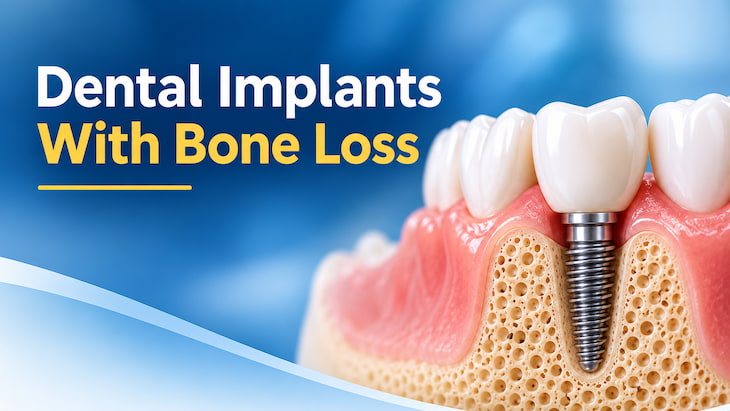
Dental implants with bone loss are often still possible, but a dentist first needs to measure the jawbone and may need to rebuild it or choose a different type of implant. Maybe another office told you that you do not have enough bone, and now you wonder: can you get dental implants with bone loss?
This guide explains why implants need bone, how a dentist checks it, which options exist, and what to ask at a consultation. No result is guaranteed, and only an exam and a 3D scan can show what is possible for you.
Can You Get Dental Implants With Bone Loss?
Often, yes. The answer depends on how much bone is left, where it is, and your general health. A dentist determines it with an exam and a 3D scan, not with a guess. Two paths are common: rebuild bone so an implant has a sound base, or use an implant design that relies on the bone you already have.
The American Association of Oral and Maxillofacial Surgeons says bone grafting aims to create good quantity and quality of bone at the planned site, which is the first path. No result is guaranteed, and some people need other care first. You can read more about dental implants at Noah Smile Group.
Why Implants Need Bone, and Why the Jaw Can Shrink
An implant holds because bone grows around it. The American Dental Association explains that this process, called osseointegration, means the implant combines with the bone, and it takes time.
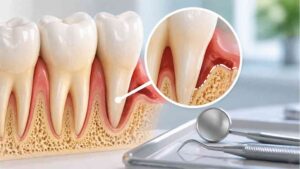
Bone can also be lost. The American Academy of Periodontology says that when bone is lost to gum disease or tooth loss, you may be left without enough bone for implants. After an extraction, the jawbone that supported the tooth can deteriorate or be resorbed. The alveolar ridge, the part of the jawbone that held the teeth, is also studied in people who wear dentures, as in a 2021 systematic review of 19 longitudinal studies. Our guide to what causes bone loss in teeth has more detail.
What Happens If You Do Not Have Enough Bone for Dental Implants?
A standard implant may not hold steady in thin or short bone. The American Academy of Periodontology lists enough bone in the jaw to support the implant as a basic requirement. So the dentist will usually suggest one of three paths: rebuild bone first, use a different implant design, or choose a non-implant option such as dentures.
Hearing “not enough bone” is a planning result, not a final no. If a tooth still needs to come out, bone protection can be planned at the time of the tooth extraction, which the American Association of Oral and Maxillofacial Surgeons describes as socket preservation. A scan is a reasonable first step either way, and a second opinion is fair.
How a Dentist Checks Your Bone
Dentists use two kinds of images. A panoramic X-ray gives a wide view for the first assessment, and a CBCT scan, which is a 3D scan of the jaw, helps plan the implant. The American Dental Association’s January 2026 recommendations call for panoramic radiography for initial assessment and CBCT for presurgical planning and placement of dental implants. The FDA notes that dental CBCT provides three-dimensional information and is used in implant planning.
These images help your dentist judge the height, width, and density of your bone. At Noah Smile Group, the dentist uses an exam and a 3D scan to decide what each patient needs before starting dental implants.

Ways to Place Implants When Bone Is Low
Dental implants for bone loss can be planned in more than one way, and the right choice depends on your scan. You can see the implant options when bone is low in the table below:
Option | What it does | Often considered when | Ask your dentist |
Bone graft (ridge augmentation, socket preservation) | Adds bone to a thin or short area | The ridge is too narrow or short | Which material, how long before the implant, and the risks |
Sinus lift | Lifts the sinus floor and adds graft material | Upper back teeth with thin bone under the sinus | How long healing takes and what sinus problems to watch for |
Zygomatic implants | Longer implants anchored in the cheekbone | Severe upper jaw bone loss | Whether the scan shows a fit, and whether a graft can be avoided |
All-on-4 or All-on-X dental implants | Supports a full arch on four or more implants, some angled | Many or all teeth are missing and bone is reduced | Whether bone at each site is enough, or a graft is also needed |
Other designs (mini, tilted, pterygoid, subperiosteal) | Use the bone already present | Used by some dentists in selected cases | Whether any apply to you |
Bone Grafting and Sinus Lifts
In ridge augmentation, the gum is lifted and the missing area is filled with bone or a bone substitute. Common graft materials are your own bone (an autograft), human donor bone (an allograft), animal bone (a xenograft), and synthetic material, and a membrane often protects the graft.
A sinus lift, also called sinus augmentation, raises the sinus floor in the upper back jaw. The implant usually waits until the bone has developed, though some cases combine both steps. Our bone grafting page lists risks of infection or swelling, graft failure, an exposed membrane, and sinus problems after a sinus lift. We also offer platelet-rich plasma (PRP), made from your own blood, in some procedures.
Zygomatic Implants for Severe Bone Loss
A zygomatic implant is a longer implant anchored in the cheekbone instead of the upper jaw. The American Association of Oral and Maxillofacial Surgeons says it can help people who may not be candidates for traditional implants. For dental implants with severe bone loss in the upper jaw, our office says zygomatic implants can often avoid a graft, but fit depends on your scan.
A 2021 meta-analysis of 46 studies reported high implant survival and sinus complications in about 5 percent of cases, and its authors noted these implants are not recommended as a first-line option.
All-on-4 and Full-Arch Options
All-on-4 places four implants in a jaw to hold a fixed bridge, with two near the front and two angled toward the back, as our All-on-4 full mouth implants page explains. All-on-X means four or more implants chosen to fit your mouth. The scan shows whether the bone at each site is enough. The American Academy of Implant Dentistry lists possible problems such as broken bridges, implant failure, and infection around the implants, so ask about them.

Other Designs
You may also hear about mini, tilted, pterygoid, and subperiosteal implants. The American Academy of Periodontology says subperiosteal implants are generally for people who do not have enough bone height for a standard implant. Ask whether any apply to you.
Who May Not Be a Candidate for Dental Implants?
Bone is only one factor when planning dental implants with bone loss. The ADA says your health is more of a factor than your age. Some conditions and habits can slow healing or raise risk:
- Chronic illness. The ADA says conditions such as diabetes may interfere with healing after surgery.
- Tobacco use. The ADA says tobacco can slow healing as well.
- Untreated gum disease. The American Academy of Periodontology lists healthy gum tissue, free of periodontal disease, as a requirement.
The American Academy of Implant Dentistry says you and your dentist should review your health history first. Bring a list of every medicine you take, and read why to tell your dentist about your medicines. In some cases, these issues can be managed first, including through periodontal care, so for some people the answer is “not yet,” not “never.”
Can You Get Dental Implants If You Have Bone Loss in Your Gums?
Bone loss in the gums usually means gum disease (periodontitis) has damaged the bone around the teeth. The answer is often yes, but gum disease is usually treated first so the area is healthy. The American Academy of Periodontology says implants may be an option for people who lost teeth to periodontal disease. Noah Smile Group’s gum care includes gum disease treatment and LANAP laser gum treatment. Past gum disease also remains a risk factor for problems around an implant. Our post on the signs and treatment of bone loss explains what to watch for.
Can Bone Loss Happen Around an Implant?
Yes, it can. Some people worry that bone loss makes dental implants a bad idea. Bone loss before an implant is a planning issue, not an automatic no, but bone loss around an implant after surgery can happen too.
The American Academy of Periodontology separates two problems. Peri-implant mucositis is gum inflammation around the implant with no bone loss, and it may be reversible if caught early. Peri-implantitis is inflammation with loss of the bone that supports the implant, and it usually needs surgical treatment.
Risk factors include previous gum disease, poor plaque control, smoking, and diabetes. The AAP recommends regular brushing, flossing, and check-ups, plus routine monitoring of implants, so keep your maintenance visits.
Implants vs. Dentures When the Jaw Has Shrunk
Traditional dentures rest on the gums, so many people with a shrunken jaw can still wear them, although they may move. Implants can add hold. The table below compares dentures and implant options.
Feature | Traditional dentures | Implant-supported dentures (overdentures) | Fixed full-arch implants (All-on-4) |
How it stays in place | Rests on the gums | Snaps onto 2 to 4 implants | Fixed on implants and not removed at home |
Bone needed | None placed in the jaw | Enough bone at the implant sites | Enough bone at the implant sites, or added bone |
Effect of a changing jaw | Fit can change over time, so relines or new dentures may be needed | Implants hold the denture, but the plan still depends on bone health | Depends on bone health and care |
Daily care | Remove and clean daily | Remove and clean daily, plus clean around the implants | Clean around the teeth and implants, with regular check-ups |
Learn more about traditional dentures, and implant-supported dentures.
How Much Do Dental Implants Cost With Bone Loss?
We do not list prices here because cost depends on your plan. The number of implants, whether a graft or sinus lift is needed, the graft material, the type of sedation, and the final teeth all move it. We give a written plan after an exam and a 3D scan, and the final cost may change if your treatment changes.
We are out-of-network with dental insurance and file claims so you can receive any out-of-network benefits your plan allows. Coverage varies, and filing a claim does not guarantee payment. For payment plans and financing, we work with CareCredit, Sunbit, Proceed Finance, and Allegro Credit, subject to lender approval. Please confirm benefits and terms with us, and see our insurance and financing page.
Next Steps If You Have Been Told You Do Not Have Enough Bone
In short, whether dental implants with bone loss are possible for you depends on your scan and your health. There is more than one way to work with low bone, from grafting to zygomatic and full-arch designs. A second opinion is a reasonable step if you were told no.

Why Choose Noah Smile Group for Complex Implant Cases?
Noah Smile Group focuses on full mouth implants, including All-on-4 and zygomatic implants, at our Brooklyn office. Dr. Moise Nawlo, DDS, earned his Doctor of Dental Surgery at New York University College of Dentistry and has been a Fellow of the International Congress of Oral Implantologists (ICOI) since 2005. Both of our doctors trained at NYU College of Dentistry, and our practice was established in 2015.
We use in-office diagnostic and surgical technology to plan procedures, and we offer sedation options from nitrous oxide to IV sedation and general anesthesia. We are open Sunday to Friday.
Contact Our Dental Implant Team Today
To talk about your bone and your options, call (347) 720-9068 or request an implant consultation. Our Brooklyn office is open Sunday to Friday, 10:00 am to 5:00 pm, and closed Saturday.
FAQs
Can You Get Dentures With Bone Loss?
Usually yes, because dentures rest on the gums. The fit can change over time, and implants can help hold dentures steady, depending on your bone and health.
Is a Bone Graft Painful?
The area is numbed, and many people feel soreness that improves over several days. Ask about sedation options.
How Long Do You Wait After a Bone Graft Before Getting the Implant?
It depends on the graft and how you heal. A follow-up exam and scan decide when the bone is ready.
Does Insurance Cover Implants and Bone Grafts?
Coverage varies by plan. We are out of network and file claims for any out-of-network benefits, so confirm your benefits.
How Long Do You Wait After a Bone Graft Before Getting the Implant?
Most patients wait 3 to 6 months after a dental bone graft before getting an implant. Larger grafts, including some sinus lifts, may require 6 to 12 months to heal fully. Minor grafting can sometimes be done during implant placement, eliminating the need for a separate waiting period.
This article is general information, not medical advice. Only a dentist who examines you can say what is possible.