Both a dental bridge and a dental implant can replace a missing tooth, but neither is right for everyone. The choice depends on your neighboring teeth, jawbone health, overall health, budget, and treatment preferences. A traditional bridge uses nearby teeth for support, while an implant replaces the missing tooth root with a post placed in the jawbone. Please keep reading to learn more about dental bridge vs implant in detail and discuss the most suitable option with your dentist.
Dental Bridge vs Implant at a Glance
The main difference between a dental implant vs bridge is how each restoration stays in place. A bridge relies on neighboring teeth, while an implant is supported by the jawbone.
Feature | Traditional Dental Bridge | |
Support | Neighboring natural teeth | Jawbone |
Surgery | No implant surgery | Requires surgical placement |
Treatment time | Usually a few weeks | Often several months |
Adjacent teeth | Supporting teeth are reshaped | Neighboring teeth remain untouched |
Jawbone | Does not replace the missing root | Replaces the root and provides functional loading |
Initial cost | Generally lower | Generally higher |
Longevity | May require replacement over time | Implant post can last many years; crown may need replacement |
Cleaning | Requires cleaning underneath the artificial tooth | Requires brushing and cleaning around the crown |
Suitable for | Patients with suitable supporting teeth | Patients with sufficient bone and healthy gums |
Source: Cleveland Clinic
How a Dental Bridge and an Implant Work
Both treatments fill the space left by a missing tooth, but their structures and placement procedures are different.
How Does a Dental Bridge Work?
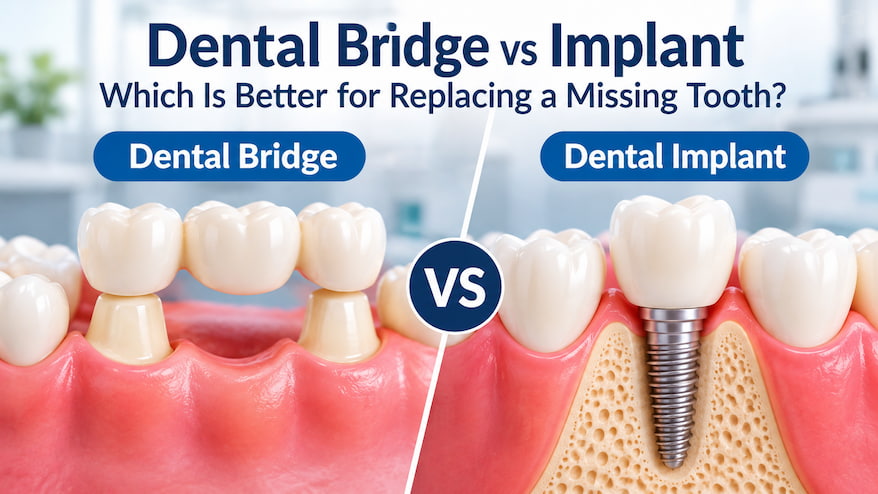
A traditional dental bridge replaces a missing tooth with an artificial tooth called a pontic. The pontic is connected to dental crowns placed over the natural teeth on either side of the gap. These supporting teeth are called abutment teeth. (Wellpoint)
To prepare the supporting teeth, the dentist removes some enamel so the crowns can fit securely. The bridge is then made as one restoration and cemented into place. You cannot remove it yourself for cleaning.
A traditional bridge restores the visible part of your smile and helps with chewing, but it does not replace the missing tooth root.
How Does a Dental Implant Work?
A dental implant replaces the missing tooth root with a small post, usually made of titanium. The dentist or implant surgeon places this post into the jawbone during surgery.
After placement, the bone gradually grows around and bonds with the implant. This process is called osseointegration and provides the foundation for the replacement tooth.
Once healing is complete, the dentist attaches an abutment, a small connector that holds the final dental crown in place. The crown is the visible part that resembles a natural tooth.
Unlike a traditional bridge, a single implant does not depend on neighboring teeth for support. It can therefore replace a missing tooth without reshaping otherwise healthy teeth.
How Does an Implant-Supported Bridge Work?
One related option is an implant-supported bridge. Instead of using natural teeth as anchors, this restoration connects several artificial teeth to dental implants. It is different from a traditional bridge and is generally used when multiple teeth are missing.
Learn more about Dental Implant Prosthesis Options

Dental Bridge vs Implant: Main Differences Explained
The right treatment depends on more than appearance or initial price. Here are the practical differences to consider.
Impact on Neighboring Teeth
- A traditional bridge requires the dentist to reshape the supporting teeth. This involves permanently removing some enamel, even if those teeth are otherwise healthy.
- An implant, on the other hand, stands independently. The dentist generally does not need to alter the neighboring natural teeth to place it.
Jawbone Health and Bone Loss
Your bone changes after tooth loss as a natural physiological process. Therefore, your jawbone density and health become an important factor.
- A traditional bridge replaces the visible tooth but does not replace its root. As a result, it does not provide the same functional loading to the bone beneath the missing tooth.
- A dental implant acts as an artificial root and transfers chewing forces to the jawbone. It can help maintain bone at the implant site, but it does not eliminate all bone remodeling or guarantee that bone levels will remain unchanged.
Treatment Duration and Recovery
- A dental bridge is usually completed faster than an implant. The process generally involves preparing the supporting teeth, taking dental impressions, making the restoration, and cementing the final bridge.
- Implant treatment involves additional steps. After surgical placement, the implant needs time to bond with the jawbone in three to nine months.
Appearance, Comfort, and Function
Both treatments are designed to look like natural teeth and restore chewing function. The final appearance depends on the restoration material, the dentist’s planning, and the condition of the surrounding gum tissue.
Cleaning and Maintenance
Neither restoration is maintenance-free.
- With a traditional bridge, food and plaque can collect underneath the artificial tooth. You may need a floss threader or another cleaning aid to reach this area.
- An implant crown can usually be brushed and cleaned around the gum line much like a natural tooth. However, implants still require careful oral hygiene and regular dental examinations to monitor the surrounding gum and bone.
Cost & Insurance Coverage
- A traditional bridge generally costs less upfront,
- An implant involves several components and may require additional procedures, which leads to higher costs.
However, a lower initial price does not necessarily mean lower expenses over time. A traditional bridge may need replacement if the restoration wears down or its supporting teeth develop problems. An implant post can remain functional for many years, but the crown may also need repair or replacement.
For example, when comparing a 3 tooth implant bridge cost, remember that this is a different treatment plan from replacing one missing tooth with a single implant. An implant-supported bridge uses implants to support several replacement teeth, so its price depends on the number of implants, the restoration, and the additional procedures required.
A 2024 systematic review of tooth-supported and implant-supported restorations also documents biological and technical complications with both types of restoration.
Does Dental Insurance Cover Bridges and Implants?
Dental insurance coverage depends on your individual plan. Some plans provide benefits for traditional bridges but offer limited coverage or exclusions for implants. Check your policy and request a pretreatment estimate before starting treatment.
Noah Smile Group is out-of-network with dental insurance. However, the team can help file claims and paperwork for any out-of-network benefits your plan allows. The practice also works with patients on payment arrangements and third-party financing options.
Learn more about dental implant costs and financing options.
Pros and Cons of Dental Bridges and Dental Implants
A traditional bridge can be a practical tooth replacement option, particularly when the supporting teeth already need restorative treatment. Dental implants provide an independent replacement for a missing tooth. However, they involve surgery, a longer treatment process, and a higher initial investment in many cases.
Treatment | Advantages | Disadvantages |
Dental Bridges | Lower initial cost Faster treatment No implant surgery Restored appearance and function Useful for damaged neighboring teeth | Permanent changes to supporting teeth Risk to abutment teeth No replacement of the tooth root Additional cleaning Possible future replacement |
Dental Implants | Preserve neighboring teeth Replace the missing root Support the jawbone Independent support Long-term potential Familiar cleaning routine | Higher upfront cost Surgical placement Sufficient bone required Longer treatment Not suitable for everyone Ongoing maintenance |
When Is a Dental Bridge Better Than an Implant?
When comparing dental bridge vs implant, there are five situations where a bridge may be worth considering.
- If the teeth beside the missing tooth have extensive restorations or structural damage, a bridge may address both problems together.
- You want to avoid implant surgery.
- You have insufficient jawbone.
- You prefer a shorter treatment timeline.
- Your budget is limited, which makes implant treatment not financially practical at present.
When Is a Dental Implant Better Than a Bridge?
An implant may offer more advantages in these situations:
- Your neighboring teeth are healthy.
- You have sufficient jawbone.
- Long-term replacement is a priority.
- You want to maintain bone at the missing-tooth site.
- You want an independent restoration.
It’s worth noting that having insufficient bone does not necessarily rule out implants. Depending on your condition, bone grafting may help create a suitable foundation.

Why Choose Noah Smile Group for Dental Implant Treatment?
At Noah Smile Group, treatment recommendations are based on your oral health, diagnostic findings, and individual needs. The practice focuses on implant dentistry, including single dental implants and full-mouth restoration. Dr. Moise Nawlo, DDS, earned his dental degree from New York University College of Dentistry and has been a Fellow of the International Congress of Oral Implantologists (ICOI) since 2005.
Established in 2015, Noah Smile Group also offers sedation options ranging from nitrous oxide to IV sedation and general anesthesia.
Discuss Your Tooth Replacement Options at Noah Smile Group
If you are comparing a dental bridge and an implant, a consultation can help you understand which option suits your dental health and treatment goals. The team at Noah Smile Group can evaluate your teeth, gums, and jawbone and discuss suitable restoration options.
Call (347) 720-9068 or schedule a consultation at Noah Smile Group, 1918 Avenue U, Brooklyn, NY 11229.
Frequently Asked Questions
Why Does a Doctor Prefer a Bridge Over an Implant?
A dentist may prefer a bridge when the neighboring teeth already need crowns, the patient wants to avoid surgery, or implant placement would require additional procedures. A bridge may also be more practical when treatment time or upfront cost is a concern.
Why Would a Dentist Not Recommend a Bridge?
A dentist may not recommend a traditional bridge when the neighboring teeth are healthy and would need unnecessary reshaping. It may also be unsuitable if the supporting teeth are too weak to hold the restoration securely.
What Does a One-Tooth Dental Bridge Cost?
A traditional bridge replacing one missing tooth usually consists of three connected units: two supporting crowns and one pontic. Its price depends on the materials, condition of the supporting teeth, additional treatment, and dental practice fees.
Does a Dental Bridge Last as Long as an Implant?
Not necessarily. Both types of restoration can experience complications over time. An implant post and its crown also have different lifespans, so the post’s continued function should not be confused with the durability of the visible crown.
Is Getting a Dental Implant More Painful Than Getting a Bridge?
Implant placement involves surgery, but local anesthesia is used to numb the treatment area. Some swelling and soreness may occur during healing. A bridge does not require implant surgery, although preparing the supporting teeth can cause temporary sensitivity.
Can I Get an Implant After Having a Dental Bridge?
In many cases, yes. However, the dentist must assess the condition of the supporting teeth, jawbone, and gum tissue before deciding whether implant placement is appropriate.
Can a Dental Bridge Cause Bone Loss?
A traditional bridge does not cause bone loss directly, but it does not replace the missing tooth root or provide the same direct functional loading to the bone beneath the pontic. After a tooth is lost, the alveolar bone at that site can continue to remodel and gradually resorb. An implant-supported bridge, by contrast, replaces the root and transmits chewing forces into the jawbone, which can help preserve bone volume at the site.